
Semaglutide Research Peptide UAE: Documentation Guide

Updated: Oct 1
Sourcing semaglutide for research in the UAE means navigating a market flooded with generic marketplace listings. Most of these pages show a product name, a pre-filled pen photo, and little else. No batch number. No lab report. No way to confirm what's actually inside the pre-filled pen. This article sets out what a documentation-focused semaglutide research peptide supplier should provide, how purity testing works, and what to check before you buy.
Semaglutide Research Applications and the UAE Regulatory Framing
Semaglutide is a GLP-1 receptor agonist studied extensively in metabolic research. Labs use it to investigate glucose regulation, appetite signaling, and related endocrine pathways. It is not sold here for human consumption, self-administration, or clinical treatment. Every listing referenced in this article is positioned strictly as a research compound for qualified laboratories and researchers.
That distinction matters for buyers in the UAE. Research peptides sit in a different regulatory category than pharmaceutical products meant for patient use. Suppliers operating in this space need to be explicit about that boundary. Buyers need to understand it before they place an order. For a deeper look at how this framing applies across the region, the UAE peptide sourcing regulations guide covers the compliance landscape in more detail.
What 'research-only' positioning means for GLP-1 compounds
"Research-only" means the product is sold and labeled for laboratory use, not for ingestion or injection into humans or animals outside a controlled research setting. Compounds sold this way carry no dosing instructions for personal use. Any supplier who buries that distinction, or actively markets around it, is signaling a compliance problem rather than a research-grade product.
This framing protects both the supplier and the buyer. It also explains why documentation, not marketing language, is the real basis for evaluating a semaglutide listing. That's the subject of the next section.
Why COA Verification Matters When You Buy Semaglutide Peptide in the UAE
A Certificate of Analysis, or COA, is the document that turns a semaglutide listing from a claim into a verifiable product. A Class Apart provides UAE delivery information and storage guidance. Researchers should confirm the packaging and temperature-handling arrangements required for a specific material before ordering. Buyers should expect that as a baseline, not a premium add-on.
Without a COA, a buyer has no way to confirm the compound's identity, its purity, or which production run it came from. Unverifiable overseas resellers targeting GCC buyers tend to operate in exactly that gap.
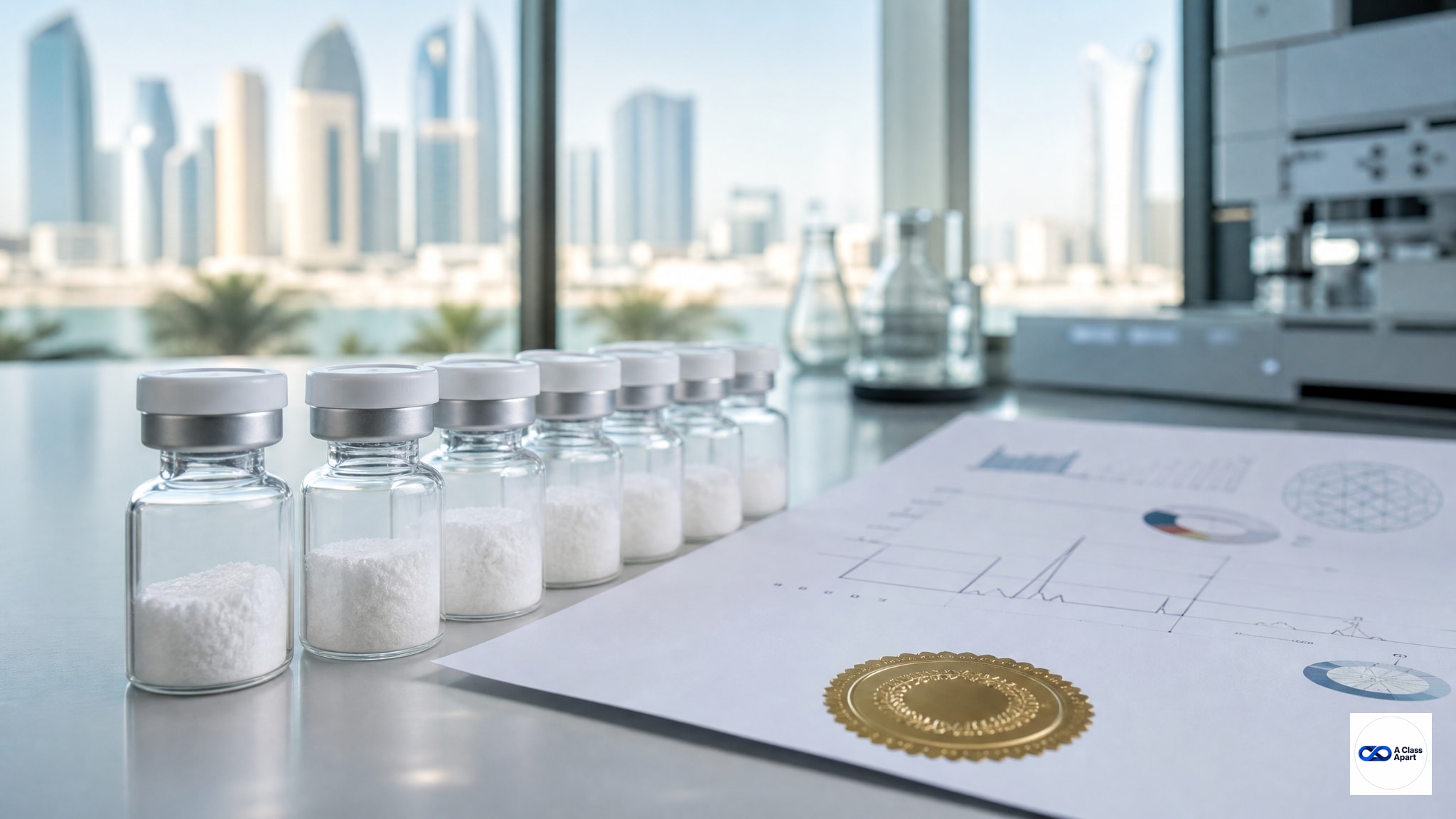
What a semaglutide research peptide COA should include
A proper semaglutide research peptide COA should show, at minimum:
The HPLC purity percentage for that specific batch, not a generic company average
Molecular weight confirmation, typically via mass spectrometry, matching semaglutide's expected profile
A batch or lot number that ties the certificate to the physical pre-filled pen
The testing laboratory's identity and the test date
The reference standard or method used for the analysis
If any of these are missing, the certificate isn't doing its job. For readers who want the full breakdown of what a compliant certificate looks like, the article on how a Certificate of Analysis is structured walks through each field in detail.
Common gaps in unverifiable overseas listings
A generic marketplace listing with no COA link, no batch number, and a stock photo is a common pattern among overseas resellers targeting GCC buyers. It's the opposite of what a documented research purchase should look like. Some listings display a COA image that can't be traced to the batch actually shipped. Others show a purity figure with no testing lab named at all.
Researchers evaluating any GLP-1 peptide supplier should treat the absence of a batch-specific COA as a disqualifying red flag, not a minor gap. A missing or generic document isn't an oversight. It's a sign the seller cannot, or will not, prove what's in the pre-filled pen.
Purity and HPLC Testing Standards for GLP-1 Research Peptides
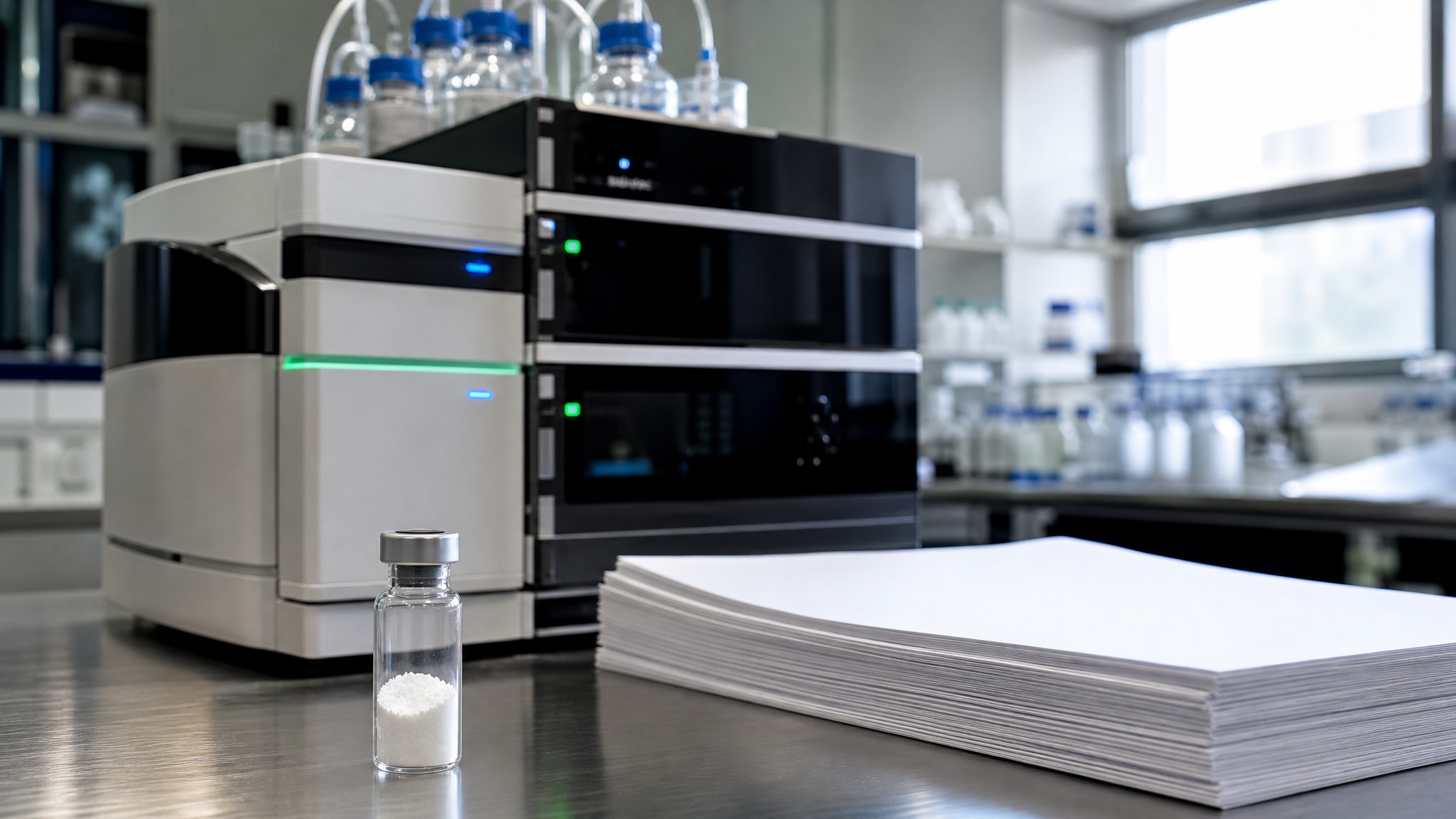
High-Performance Liquid Chromatography, or HPLC, is the standard method for measuring peptide purity. It separates a sample into its component compounds and measures the proportion made up by the target molecule, semaglutide in this case, versus impurities or degradation products.
Reputable peptide manufacturers typically report HPLC purity in the high 90s (commonly 98%+) for research-grade semaglutide. The exact figure varies batch to batch and belongs on the COA, not the product page. A number quoted on a website with no accompanying lab report is a claim, not a result. The distinction matters because purity can vary between manufacturing runs even from the same source.
How HPLC purity percentage is determined and reported
An HPLC test runs a dissolved sample through a column, and a detector records each compound as it elutes. The area under the semaglutide peak, relative to the total area of all detected peaks, gives the purity percentage. That figure, along with the chromatogram itself, should appear on the batch-specific COA.
Buyers who want to understand the mechanics in more depth, or compare HPLC against other analytical methods, can review peptide purity testing methods for a fuller technical explanation. It's also worth knowing how to independently check a supplier's numbers. The guide on how to verify a supplier's HPLC test results covers practical steps for cross-referencing a certificate against the batch you actually received.
Semaglutide Pre-filled Pen Storage and Reconstitution Guidance for Research Use
Lyophilized semaglutide is chemically stable in its freeze-dried, powder form, but that stability depends on correct storage from the point of shipment through the point of use in a lab.
Storing lyophilized semaglutide in GCC climate conditions
The UAE's heat and humidity make cold-chain discipline a real, practical concern rather than a formality. Lyophilized peptides generally need refrigerated storage, shielded from light and moisture, once they arrive. Leaving a pre-filled pen exposed to ambient heat, even briefly, can speed up degradation and undermine the purity documented on its COA.
Labs receiving shipments in this climate should have refrigeration ready before the delivery arrives, not arranged afterward. For a fuller look at handling lyophilized compounds in Gulf conditions, storing lyophilized peptides in hot, humid climates covers the practical details.
Reconstitution best practices before research use
Reconstitution is the process of dissolving the lyophilized powder in a diluent, typically bacteriostatic water, immediately before laboratory use. Sterile technique matters at every step. Swab the pre-filled pen top with alcohol, use a sterile syringe, and add the diluent slowly along the pre-filled pen wall rather than directly onto the powder. This avoids excess foaming that can affect the compound.
Once reconstituted, semaglutide has a limited window of stability. Researchers should refrigerate it and use it within the timeframe set by the specific research protocol. This is general handling guidance for laboratory settings, not a dosing framework for personal use.
Semaglutide vs Other GLP-1 Research Peptides
Semaglutide is one of several GLP-1 receptor agonists studied in metabolic and endocrine research. Understanding where it sits among these compounds helps researchers choose the right peptide for a given study design.
How semaglutide compares to other GLP-1 compounds in research contexts
GLP-1 research peptides differ mainly in molecular structure, receptor binding characteristics, and half-life. These factors shape the kind of study a compound suits. Semaglutide's structure has been widely characterized in published metabolic research, which is part of why it's a common reference compound in comparative GLP-1 studies. Researchers choosing between semaglutide and other GLP-1 peptides typically weigh the specific mechanism under investigation, existing published data on the compound, and the purity documentation available for the batch in hand.
None of this is a basis for health claims. It's simply a note on how researchers narrow down which GLP-1 compound fits a given protocol, and why documented purity and identity data matter regardless of which peptide is chosen.
Choosing a documentation-focused GLP-1 Research Peptide Supplier in the GCC
For labs and researchers across the GCC, choosing a semaglutide supplier comes down to documentation and traceability. Region-specific sourcing matters too. A supplier operating within the GCC can offer more consistent cold-chain handling and clearer accountability than a distant overseas reseller shipping into the region.
Questions to ask before you buy semaglutide peptide UAE-wide
Before placing an order, ask the supplier directly:
Does every batch ship with its own COA, or is one certificate reused across multiple batches?
Does the COA list HPLC purity, molecular weight confirmation, and a batch number?
Can the testing laboratory be identified and, if needed, independently confirmed?
Is the product clearly labeled and marketed for research use only?
Does the supplier maintain cold-chain handling appropriate for the UAE's climate?
A supplier that answers all five clearly is operating on a fundamentally different standard than a marketplace listing with a stock photo and a price tag. For a broader view of what documented, compliant sourcing looks like across the region, the broader GCC research peptide supplier guide covers the full picture, and the checklist on how to spot the red flags of a fake peptide COA is worth reviewing before any purchase.
Researchers ready to review documentation-focused semaglutide listings, complete with batch-specific COAs, can browse the full COA Documentation research peptide catalog or contact A Class Apart directly to confirm documentation for a specific batch before ordering.
Research-use notice: For laboratory research use only. Not for human or veterinary use, and not intended to diagnose, treat, cure, mitigate or prevent disease.
Explore the A Class Apart research catalogue or enquire via WhatsApp on +971 52 627 8691. Free UAE delivery is available on orders from AED 1,000, and payment via WhatsApp can be arranged if preferred.

Comments