
Peptide Sourcing Regulations UAE Guide for Researchers

Updated: Oct 1

Researchers based in the UAE face a genuine knowledge gap when it comes to peptide sourcing regulations UAE. Unlike pharmaceutical licensing or narcotics scheduling, both of which have clear statutory frameworks, research-grade synthetic peptides occupy a space where multiple agencies have overlapping interests but no single unified rulebook. This guide maps that landscape: which bodies govern procurement, how customs classification works, what documentation you need, and how to evaluate a supplier's compliance credentials before you place an order.
How the UAE Regulatory Framework Applies to Research Peptides
Which government bodies oversee research chemicals and peptides
Three authorities carry the most weight for a UAE-based researcher sourcing peptides.
MOHAP (Ministry of Health and Prevention) is the federal body responsible for controlled substances scheduling and pharmaceutical product registration. It maintains a controlled substances register that classifies compounds by scheduling tier. Researchers should cross-reference any compound against this register before procurement, because classification can and does change with each regulatory update cycle. The current register is accessible at mohap.gov.ae.
Dubai Health Authority (DHA) operates within the Emirate of Dubai and issues its own guidance on laboratory supplies and research materials. For researchers based in Dubai, DHA requirements layer on top of federal MOHAP rules rather than replacing them.
UAE Federal Customs Authority governs the physical movement of goods across UAE borders. Its mandate intersects with MOHAP's at the point of import: Customs relies on MOHAP classifications to determine whether a shipment requires a special permit, faces prohibition, or can enter under standard commercial documentation.
These three jurisdictions interact rather than operate in silos. That's the first practical thing to understand before building a compliant procurement process.
How UAE law distinguishes research-use compounds from controlled substances
UAE federal law draws a clear line between scheduled narcotics and psychotropic substances, licensed pharmaceuticals, and unregistered research-grade compounds. Most synthetic research peptides fall into the third category. They are not listed on the Federal Law No. 14 of 1995 controlled substances schedule, nor are they registered pharmaceutical products requiring a marketing authorisation.
This "grey zone" status does not mean unrestricted access. It means that import and use are not automatically prohibited, but are also not explicitly licensed. In practice, researchers are expected to hold documentation that demonstrates the compound's intended research purpose, its purity, and its provenance, because the absence of a formal permit makes the COA and intended-use declaration the primary evidence of legitimate procurement.
GCC Peptide Import Rules and Cross-Border Compliance
Customs classification and HS codes for peptide compounds
At GCC customs checkpoints, peptide compounds are most commonly classified under HS Chapter 29 (Organic Chemicals) or HS Chapter 30 (Pharmaceutical Products), depending on how the exporter describes the compound and how the receiving customs officer interprets the product description. The distinction matters: Chapter 30 classification can trigger pharmaceutical import controls that Chapter 29 does not.
For synthetic research peptides with no therapeutic claim on the packaging or documentation, Chapter 29 is generally the more accurate classification. Misclassification, whether due to exporter error or deliberate mislabelling, creates clearance delays and can attract regulatory scrutiny. UAE researchers ordering from international suppliers should confirm the HS code the supplier intends to declare before shipment is dispatched.
The GCC Standardization Organization (GSO) works alongside national regulators to harmonise product classification across member states. A compound's regulatory status in Saudi Arabia or Kuwait may inform, but does not automatically mirror, its status under UAE federal law. GCC-wide harmonisation is ongoing, and researchers procuring across borders should treat each country's current national register as the authoritative source.
Documentation requirements for GCC-wide peptide shipments
A UAE-based researcher or lab should have the following documentation ready before a shipment arrives at the border:
Commercial invoice with full compound name, CAS number, quantity, and declared value
Certificate of Analysis (COA) from the manufacturer, showing batch number, purity data, and analytical method
Intended-use declaration stating that the compound is for in-vitro or laboratory research, not for human or veterinary administration
Supplier's business documentation, including country of origin and export authorisation where required by the exporting country
Dubai's free zones, including DMCC and Dubai Science Park, operate under distinct customs and import regimes. A shipment cleared through a free-zone entity can face different documentation requirements than one entering via a mainland UAE consignee. Researchers using a free-zone address should verify current requirements directly with their zone authority, as exemptions and restrictions are updated independently of mainland federal customs rules.
Peptide Legal Status in the UAE: What Researchers Need to Know
The practical picture for peptide legal status in the UAE breaks into three categories.
Outright prohibited compounds include any peptide analogue that appears on MOHAP's controlled substances register or that functions as a precursor to a scheduled substance. Melanotan II, for example, sits in a more restricted position in several jurisdictions because of its pharmacological profile, and researchers should confirm its current MOHAP classification before procurement.
Compounds requiring special import permits typically include peptides with established therapeutic applications, such as licensed pharmaceutical peptides being imported for comparative research, where the compound exists in a registered pharmaceutical form elsewhere. MOHAP may require a research institution letter, an ethics committee approval reference, or a MOHAP import permit for these.
Compounds sourceable for research with standard documentation represent the majority of synthetic research peptides. These are not scheduled, not pharmaceutically registered in the UAE, and can be imported for laboratory use provided the researcher holds a complete documentation trail: COA, intended-use declaration, and commercial invoice.
This article provides factual orientation, not legal advice. Researchers should verify the current status of any specific compound directly with MOHAP before placing an order, because the register is updated on a rolling basis.
Research Peptide Compliance UAE: Quality and Documentation Standards
Why a Certificate of Analysis is your primary compliance document
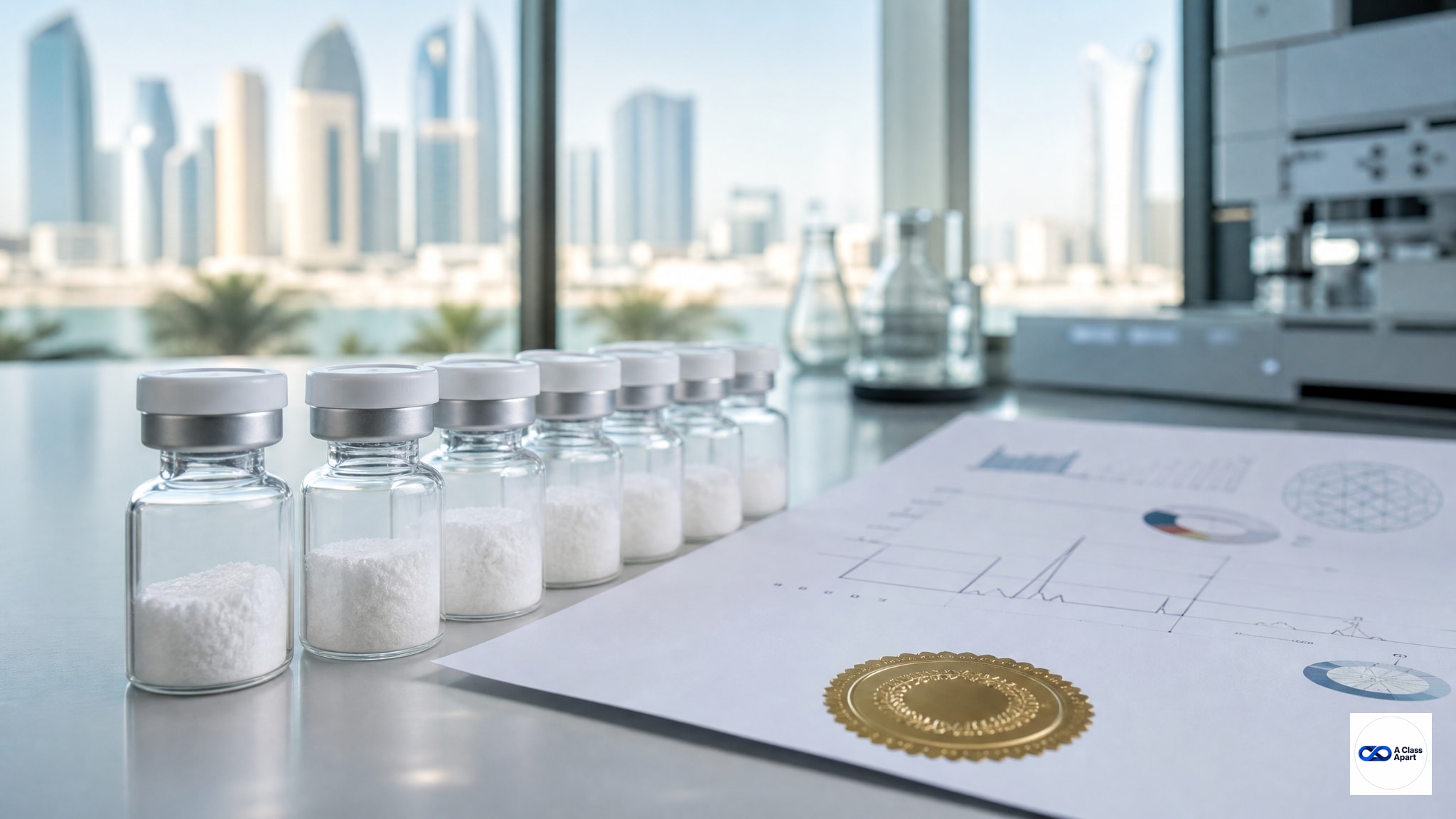
For a UAE-based researcher, the COA is both a quality instrument and a compliance anchor. It is the document that demonstrates, to customs, to institutional ethics boards, and to any regulatory inspection, that the compound is research-grade, correctly identified, and not misrepresented.
A credible COA includes the compound name, CAS number, batch number, synthesis date, expiry or retest date, purity result, and the analytical methods used to derive that result. Understanding what a Certificate of Analysis actually contains helps researchers distinguish a genuine compliance document from a one-page summary that provides no verifiable data.
Researchers can browse the A Class Apart catalogue and request the available documentation for a specific product and batch before ordering.
Purity thresholds and testing standards expected in a UAE research context
HPLC (High-Performance Liquid Chromatography) paired with mass spectrometry confirmation is the internationally recognised dual-method standard for verifying synthetic peptide identity and purity. HPLC quantifies purity as a percentage of the target compound relative to all detected species. Mass spectrometry confirms molecular identity by matching the observed mass to the theoretical molecular weight of the peptide.
For research-grade peptides, ≥98% purity by HPLC is the standard benchmark that leading suppliers apply before issuing a COA. Compounds falling below this threshold may carry impurity profiles that compromise experimental reproducibility and, in a UAE compliance context, may invite questions about whether the compound is correctly represented. This benchmark is consistent with ICH Q6A guidance on specifications for new chemical entities.
Building a Compliant UAE Peptide Supply Chain
Evaluating domestic vs. international suppliers
UAE researchers face a practical choice: source from a GCC-based supplier or import directly from an international manufacturer. Each path carries different compliance burdens.
A GCC-based supplier has already navigated the import process once, the compound is in-region, documentation has been tested against UAE customs requirements, and lead times are shorter. This is the lower-friction option for most researchers. Our quality and compliance guide for GCC research peptide suppliers covers the evaluation criteria in detail.
Importing directly from an international supplier gives researchers access to a wider catalogue and, in some cases, lower unit costs. The researcher then carries the full documentation burden at the border, however. The intended-use declaration, correctly classified HS code, and supplier COA must all be in order before the shipment departs, not after it arrives at a UAE port.
When sourcing research peptides within the UAE, researchers should also confirm whether their institution's ethics or procurement committee requires pre-approval for imported research chemicals. Many UAE academic and private research institutions have internal controls that sit above the federal minimum.
Red flags that signal a non-compliant or unverified vendor
Certain vendor behaviours make it structurally impossible to maintain a compliant documentation trail. Treat the following as disqualifying:
No COA, or a COA without batch-specific purity data. A generic certificate that does not reference a specific batch number is not traceable and will not support a compliance audit.
No identifiable country of origin or manufacturer details. A vendor who cannot name the synthesis facility cannot provide the provenance documentation that UAE customs may request.
Purity claims without stated analytical method. "99% pure" without specifying HPLC or another validated method is a marketing claim, not analytical data.
No CAS number or incorrect CAS number on product pages. This is a basic identity verification failure.
Vague or absent intended-use language. Compliant vendors state research use explicitly; those who avoid the topic may be marketing to non-research end users.
No verifiable business registration or contact address. Regulatory traceability requires a vendor who can be audited.
Verifying peptide quality before you place an order is the practical first step, and the COA is the single most useful instrument for doing so.
Responsible Research Practices for Peptide Procurement in the UAE
Compliance is not a one-time checklist at the point of purchase. It covers the full lifecycle of the compound in your facility.
Record-keeping should include purchase orders, COAs, customs clearance records, and any intended-use declarations, stored per batch, accessible for inspection. Most UAE research institutions recommend retaining procurement records for a minimum of five years; researchers should confirm their institution's specific policy.
Storage conditions must match the compound's stability requirements and should be documented. Peptides stored outside specified temperature and humidity ranges may degrade, changing their purity profile, which has both scientific and compliance implications if the compound is subsequently tested.
Intended-use documentation should be maintained at the lab level, not just with the procurement team. The researcher using the compound should be able to reference the source, batch, and purity of the material in any published protocol or internal report.
Staying current with regulatory changes is the most demanding ongoing obligation. UAE and GCC peptide regulations developed materially through 2026 and will continue to evolve through 2027 and beyond. MOHAP publishes updates to its controlled substances register, and the GSO periodically revises harmonised classification guidance. Monitoring these channels, or working with a supplier who tracks regulatory developments on your behalf, is the most reliable way to avoid a compliance gap between purchase cycles.
For researchers who have worked through this landscape and are ready to source, BPC-157 as a worked example of a documentation-focused UAE-sourced peptide illustrates how compliant documentation looks in practice for a specific compound.
A Class Apart provides UAE delivery information and storage guidance. Researchers should confirm the packaging and temperature-handling arrangements required for a specific material before ordering. For UAE-based researchers who now understand that the COA is the cornerstone of compliant procurement, that documentation is ready at the point of purchase.
Research-use notice: For laboratory research use only. Not for human or veterinary use, and not intended to diagnose, treat, cure, mitigate or prevent disease.
Explore the A Class Apart research catalogue or enquire via WhatsApp on +971 52 627 8691. Free UAE delivery is available on orders from AED 1,000, and payment via WhatsApp can be arranged if preferred.


Comments