
Research Peptides UAE: Laboratory Procurement Guide

Updated: Oct 1
For researchers based in the Gulf, the decision to buy research peptides UAE comes with a specific set of friction points that international vendor listings rarely acknowledge: customs unpredictability, cold-chain integrity across summer temperatures, and (most critically) the near-total absence of verifiable documentation from many suppliers operating in this market. This page addresses all three, and sets out exactly what accountable peptide sourcing looks like for the GCC research community.
Why Sourcing Research Peptides in the UAE Demands Verification
Peptides are structurally sensitive compounds. Their research utility depends entirely on what arrives in the pre-filled pen matching what was ordered, in identity, purity, and concentration. The regional market has expanded faster than its quality infrastructure, leaving researchers exposed to suppliers who compete on price and speed rather than documentation.
The GCC Peptide Supply Gap
Most vendor listings serving the Gulf are fulfillment operations, not quality-assured suppliers. They aggregate products from multiple synthesis sources, apply their own labels, and ship, often with no batch-level documentation and no independent testing. A researcher ordering BPC-157 or TB-500 from one of these vendors receives no Certificate of Analysis, no batch number, and no purity data. That makes it impossible to replicate experimental conditions or publish results with confidence in reagent integrity.
The gap is methodological, not just commercial. Research conducted with unverified peptides cannot be reproduced, cannot be peer-reviewed with confidence, and in some protocols can produce actively misleading results if impurities confound the dose-response relationship.
A Class Apart was built specifically to fill that gap: a UAE-based peptide supplier UAE researchers can access with the same documentation standards expected from the best European and North American research-grade suppliers, but with regional logistics and direct GCC accountability.
What Lab-Grade Peptides Actually Mean for Your Research
The phrase "research grade" or "lab grade" is used loosely in commercial listings. In practice, it has a specific technical meaning that every researcher should hold their supplier to.
Purity Standards and Testing Methods
Lab-grade peptides for in-vitro and in-vivo research protocols are expected to meet a minimum purity threshold of 98% as measured by HPLC (High-Performance Liquid Chromatography). Purity below this level is widely considered substandard for most experimental designs, because impurities, whether residual reagents, truncated sequences, or synthesis by-products, can confound dose-response relationships and compromise data integrity.
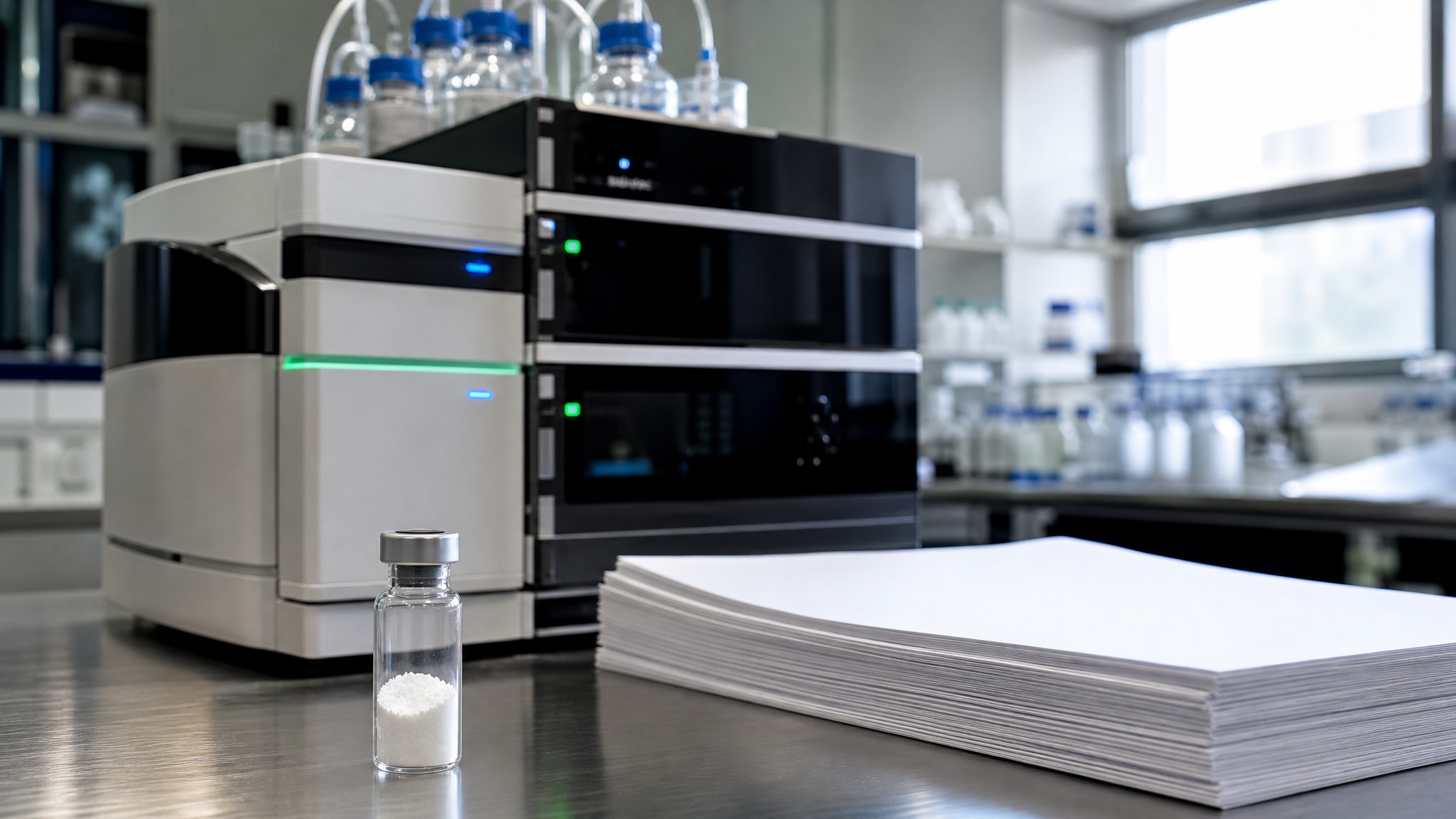
HPLC alone confirms the relative abundance of the target compound; it does not confirm molecular identity. That requires mass spectrometry. The combination of HPLC purity percentage and mass spectrometry confirmation of molecular weight is the dual-verification standard recognised across peptide research institutions for releasing a batch to researchers. A supplier offering one without the other is providing incomplete quality data.
A Class Apart provides UAE delivery information and storage guidance. Researchers should confirm the packaging and temperature-handling arrangements required for a specific material before ordering.
The Certificate of Analysis (COA): Your Non-Negotiable Sourcing Checklist
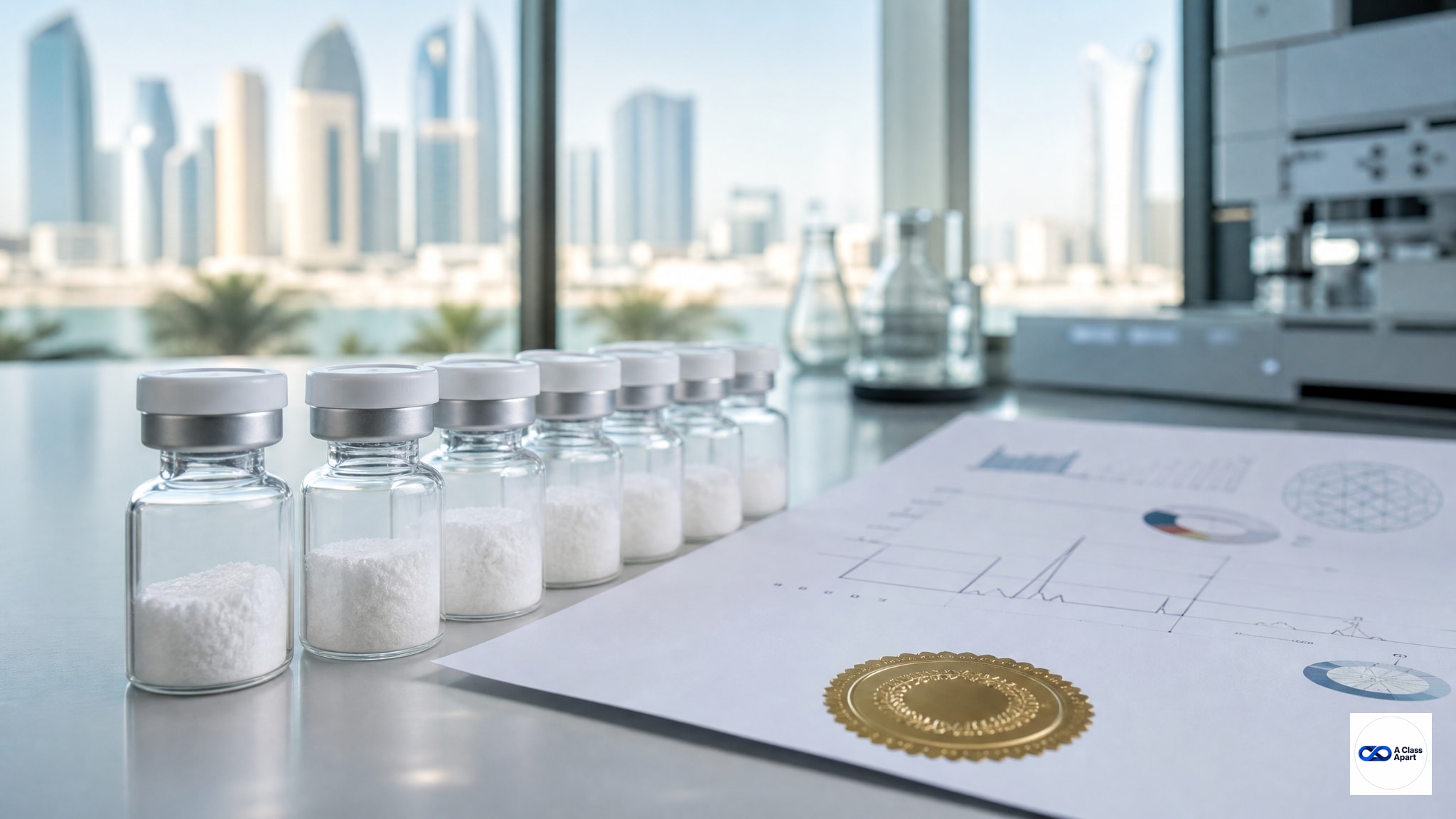
The COA is the primary trust document in any peptide purchase. It is not a marketing claim, it is a laboratory record. If a supplier cannot produce one, the conversation about purity is theoretical.
How to Read a Peptide COA
A legitimate COA for a research peptide should contain all of the following:
Batch or lot number, links the document to a specific production run, enabling traceability
Peptide identity and sequence, confirms the product matches what was ordered
Purity percentage (HPLC), expressed as a percentage with the method specified
Molecular weight confirmation (MS), the detected mass should match the theoretical mass within instrument tolerance
Date of analysis, indicates when testing was conducted; fresh analysis is preferable for time-sensitive research
Issuing laboratory identity, the testing lab should be named and independently verifiable
If any of these fields are absent, incomplete, or inconsistent with the product label, the COA is unreliable.
Red Flags When a Supplier Can't Produce a COA
The absence of a COA is itself the most significant red flag. Beyond that, watch for:
A COA provided only after purchase, not visible before order placement
A single COA applied across multiple batches (batch numbers that do not change)
No named issuing laboratory, a document produced by the vendor itself is not independent testing
Purity figures stated without specifying the testing method
Molecular weight data that is missing or does not match the peptide's known theoretical mass
Suppliers who cannot meet these basic documentation standards are not equipped for serious research supply. The risk they introduce, compromised data, failed experiments, unreproducible results, is not recoverable with a refund.
How to Buy Research Peptides in the UAE: The End-to-End Process
For Gulf-based researchers, the practical purchase journey has specific considerations that generic international vendor guides do not cover.
Peptide Purchase UAE: Ordering, Shipping, and Cold-Chain Handling
Step 1, Catalog selection. Browse the A Class Apart catalog and identify the peptide by name, sequence, and pre-filled pen size. Product pages include the COA before purchase, not as an afterthought.
Step 2, COA review before ordering. Download and review the COA for the specific batch listed. Confirm purity ≥98% HPLC, verify mass spectrometry data, and check the analysis date. This step should happen before payment, not after.
Step 3, Order placement. Orders are placed directly through the platform. A Class Apart provides UAE delivery information and storage guidance. Researchers should confirm the packaging and temperature-handling arrangements required for a specific material before ordering.
Step 4, Cold-chain shipping. Peptides are temperature-sensitive. Lyophilised (freeze-dried) peptides are more stable than reconstituted solutions, but both require controlled conditions during transit, particularly in the Gulf, where ambient temperatures routinely exceed 40°C in summer months. A Class Apart provides UAE delivery information and storage guidance. Researchers should confirm the packaging and temperature-handling arrangements required for a specific material before ordering.
Step 5, Receipt and storage. On arrival, inspect the packaging for damage or temperature excursion indicators if present. Store lyophilised peptides at -20°C and reconstituted solutions according to the product specification. The batch number on the pre-filled pen should match the COA you reviewed.
This end-to-end process addresses the three main friction points researchers in Dubai and across the GCC face with international supply: customs delays, cold-chain failure, and missing documentation.
Choosing a Peptide Supplier in the UAE: What Separates Credible GCC Vendors
When evaluating any GCC peptide vendor, apply a consistent framework. These criteria separate documentation-first suppliers from fulfillment-only listings:
COA availability pre-purchase. A credible supplier publishes the COA before you commit to an order. If you can only request it after payment, the documentation model is reactive, not transparent.
Batch traceability.A Class Apart provides available product and batch information on request. Researchers should confirm that any analytical document matches the specific lot before purchase or experimental use. Untraceable stock cannot be verified, regardless of what the label says.
Independent third-party testing. The issuing lab on the COA should be independent of the supplier. In-house testing is not equivalent and cannot be externally verified.
Regional logistics capability. A supplier based outside the GCC relies on international freight networks for cold-chain delivery into the UAE. A UAE-based operation controls that process more directly, with shorter transit times and no cross-border cold-chain handoffs.
Responsive, knowledgeable support. Researchers have technical questions about peptide stability, reconstitution, storage, and application. A supplier whose support team can answer those questions accurately is a research partner, not just a vendor.
Transparent sourcing. Lab grade peptides UAE researchers can rely on come with clear synthesis sourcing information and are not relabeled from unknown origins.
Generic vendor listings rarely satisfy more than one or two of these criteria. A documentation-first supplier should satisfy all of them.
A Class Apart provides available product and batch information on request. Researchers should confirm that any analytical document matches the specific lot before purchase or experimental use.
A Class Apart provides UAE delivery information and storage guidance. Researchers should confirm the packaging and temperature-handling arrangements required for a specific material before ordering.
For researchers in Dubai and across the GCC looking to buy research peptides UAE, this removes the core risk of the regional market: receiving a product with no verifiable quality record and no means to confirm what arrived is what was ordered.
The practical advantages are straightforward. UAE-based operations mean no customs uncertainty for domestic orders, cold-chain logistics designed for Gulf conditions, and a support team operating in the same time zone. Researchers in the wider GCC benefit from direct regional shipping without routing peptides through international freight hubs.
The catalog covers a broad range of research peptides at lab-grade purity standards. A Class Apart provides available product and batch information on request. Researchers should confirm that any analytical document matches the specific lot before purchase or experimental use. Ordering is direct and documentation is provided as standard, not on request.
To review the current catalog or submit a sourcing enquiry, contact A Class Apart directly. Every order ships with its COA. That is not a differentiator in a well-functioning market, but in the GCC peptide supply market as it currently stands, it remains one.
Research-use notice: For laboratory research use only. Not for human or veterinary use, and not intended to diagnose, treat, cure, mitigate or prevent disease.
Explore the A Class Apart research catalogue or enquire via WhatsApp on +971 52 627 8691. Free UAE delivery is available on orders from AED 1,000, and payment via WhatsApp can be arranged if preferred.
Our guide to finding high-grade peptide suppliers online provides additional checks for documentation, traceability and fulfilment.

Comments