
Certificate of Analysis Peptides Explained: The Complete Guide

Updated: Oct 1

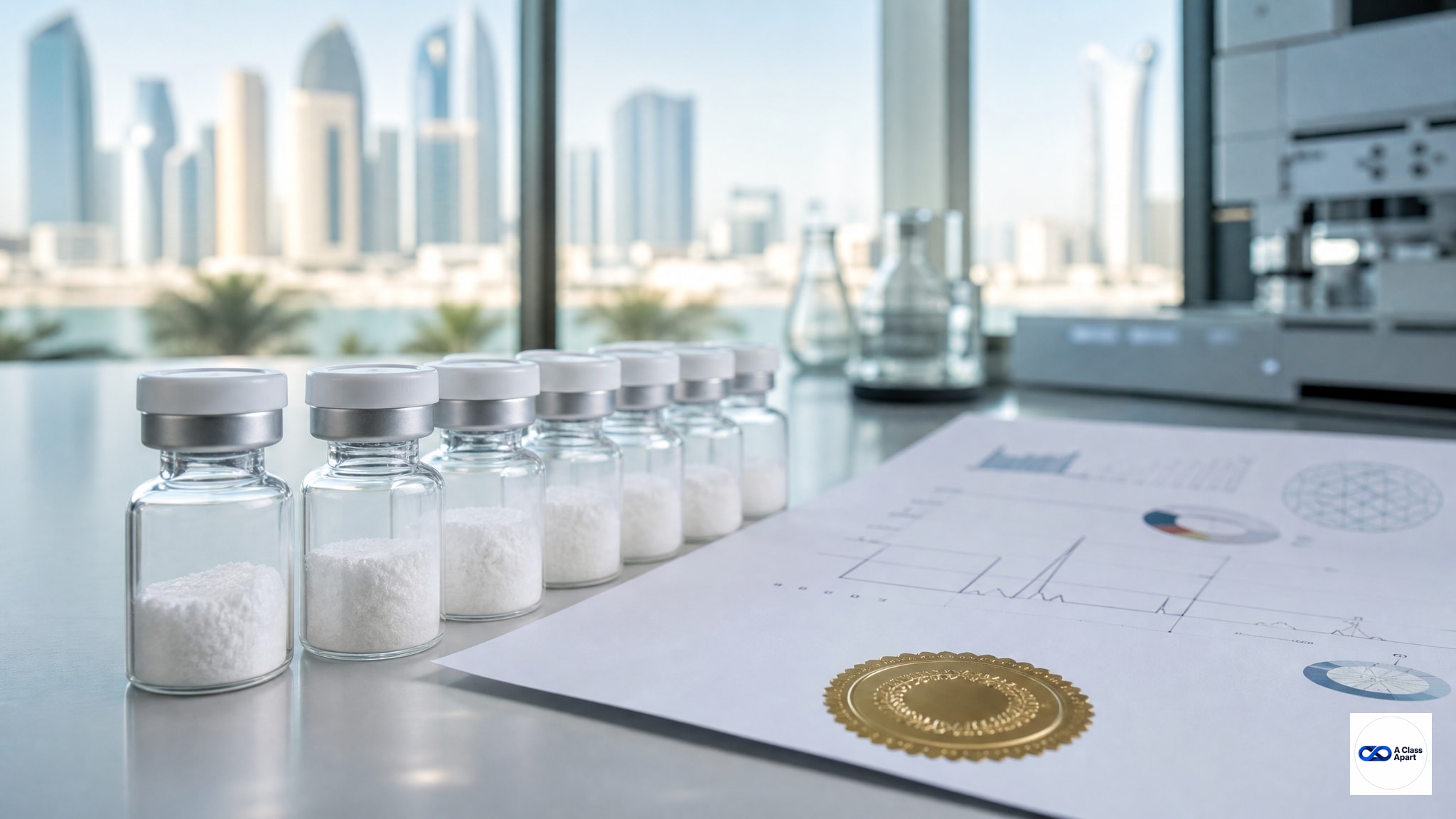
When a peptide supplier sends you a document labeled "Certificate of Analysis," the assumption is that it proves the product is what it claims to be. But not all COAs are equal. For researchers running sensitive assays, the difference between a genuine batch-specific COA and a generic placeholder document can be the difference between reproducible results and a failed experiment. This guide covers certificate of analysis peptides explained in full: what each field means, how to read the data, and how to identify documentation that falls short.
What a Certificate of Analysis Actually Is (and Why It Matters for Peptide Research)
A Certificate of Analysis is a formal document issued by an analytical laboratory. It records the measured results of specific quality tests performed on a defined batch of material. Every data point on a COA refers to that lot, not a category, not a compound in general, but the exact pre-filled pen or batch number shipped to your lab.
That distinction matters because peptide synthesis is a step-wise process with real failure modes: incomplete coupling, side-chain deprotection issues, oxidation during storage. Lot-specific testing catches these failures. A COA that reports generic or averaged values across products does not.
The difference between a COA and a product spec sheet
A product specification sheet states intended targets: the desired purity, the expected molecular weight, the planned synthesis route. It is a design document. A COA reports actual measured results for a specific lot, the purity achieved, the molecular weight observed by the instrument, the chromatogram generated on the day of testing.
If a supplier provides only a spec sheet, you have no analytical evidence about the batch in your hands. Insist on the COA.
The Core COA Fields: Peptide Purity, HPLC Trace, and MS Confirmation
Three fields carry most of the analytical weight on a peptide COA: the purity percentage, the HPLC chromatogram, and the mass spectrometry data. Each answers a different question.
How to read a peptide purity percentage from an HPLC trace
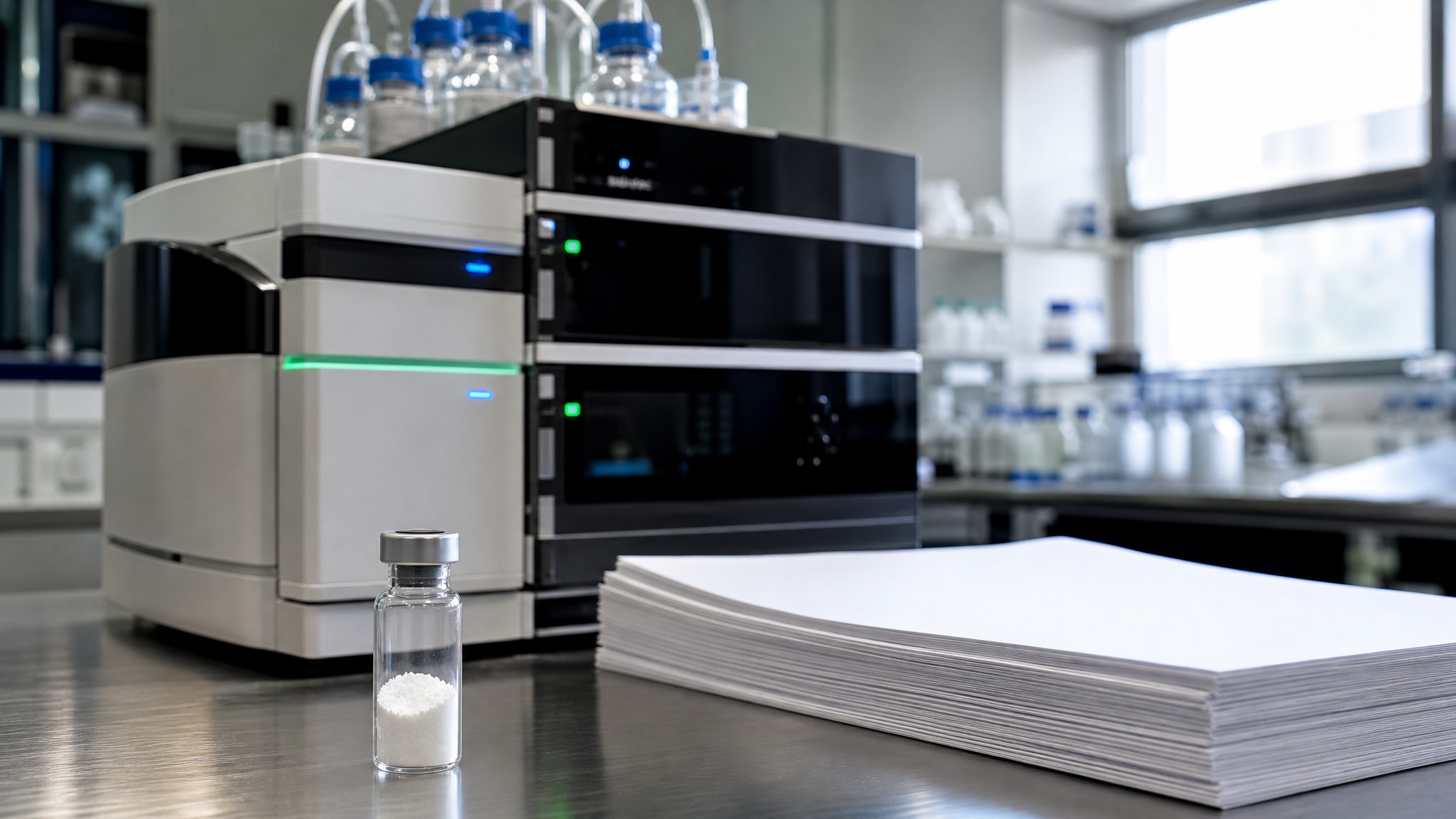
Purity is calculated by HPLC peak area integration, the industry-standard method for research-grade peptides. The instrument separates compounds by their interaction with a stationary phase under a mobile phase gradient. The area under each peak represents the proportion of that component in the sample.
The reported purity percentage reflects the target peptide's peak as a share of total peak area. A result of ≥98% means that 98% or more of the UV-absorbing material in the sample is the target compound; impurities make up the remainder. A ≥95% result is the typical threshold for research-grade use, while ≥98% is the benchmark for high-sensitivity work, cell-based assays, receptor binding studies, or in vivo models where low-level impurities could confound data.
The chromatogram image itself tells you more than the number alone. A clean, single sharp peak with flat baseline on both sides indicates a well-synthesized, well-purified batch. Shoulder peaks, small bumps on the ascending or descending slope of the main peak, suggest closely related impurities that may not be fully resolved. Elevated baseline noise across the run suggests a complex impurity profile. Both patterns warrant scrutiny, even if the reported purity figure looks acceptable.
Mass spectrometry peptide verification: what the molecular weight confirms
Where HPLC measures purity, mass spectrometry confirms identity. The MS data on a COA reports the observed m/z (mass-to-charge ratio), which translates to the molecular weight of the detected species. This is cross-checked against the theoretical molecular weight calculated from the peptide's amino acid sequence.
For small peptides, the observed molecular weight should fall within ±0.1 Da of the theoretical value. A discrepancy beyond this range is a meaningful signal, it can indicate a sequence error in synthesis, incomplete removal of protecting groups (deprotection failure), or oxidation of residues such as methionine or cysteine during handling. Any of these scenarios changes the peptide's biological activity.
Mass spectrometry peptide verification does not, on its own, confirm purity. A sample could contain the correct peptide alongside significant impurities and still show the right m/z. That is why HPLC and MS data must appear together on a credible COA. They answer different questions and neither is sufficient alone.
Secondary Quality Fields Worth Checking in Peptide Quality Documentation
Beyond purity and identity, a thorough COA includes several supporting fields that directly affect experimental outcomes.
Batch/lot number is the traceability anchor. It should match the label on the pre-filled pen you receive. If the numbers don't align, you cannot confirm you have the tested material.
Synthesis method is typically Fmoc solid-phase peptide synthesis (Fmoc-SPPS) for most research peptides. Knowing the synthesis route helps interpret potential impurity profiles and informs storage decisions.
Counterion/TFA content is frequently overlooked but experimentally significant. Trifluoroacetic acid is used in Fmoc-SPPS cleavage and deprotection steps, and residual TFA remains as the peptide counterion unless an additional exchange or removal step is performed. TFA at biologically relevant concentrations can suppress cell viability in in vitro assays, generating false-negative results that look like compound inactivity. If your work involves cell-based models, confirm the COA specifies whether TFA has been removed and replaced with a biocompatible counterion such as acetate.
Water content, typically measured by Karl Fischer titration, affects accurate mass calculation for solution preparation. High water content means the effective peptide mass per pre-filled pen is lower than the stated weight.
Storage conditions on the COA reflect stability data for that compound's specific sequence and modification profile, not a generic recommendation. Follow them.
How to Spot a Fake or Inadequate COA
The COA is only as trustworthy as the process that generated it. Knowing what a weak or fabricated document looks like is as important as knowing how to read a legitimate one.
Red flags in the document itself
No lot-specific data. If the purity figure is identical across multiple products from the same supplier, or if no lot number appears on the document, the data is almost certainly generic rather than measured.
Missing HPLC chromatogram image. A purity percentage without the underlying chromatogram is unverifiable. Legitimate peptide quality documentation always includes the trace.
MS data absent or showing wrong m/z. If mass spectrometry data is missing entirely, identity is unconfirmed. If the observed m/z does not match the theoretical weight for the stated sequence, the document may reference a different compound, or may be fabricated.
Purity reported as a range. A result like "95–98%" is not a measured value; it is a specification target. A real COA reports a single measured figure, such as "98.4%."
Red flags in the supplier's process
COA issued by the vendor, not an independent lab. In-house QC testing is not equivalent to third-party analytical verification. A supplier testing their own product has an obvious conflict of interest, and the data cannot be independently verified.
No accreditation reference. ISO/IEC 17025 is the international accreditation standard for testing and calibration laboratories. A COA from an ISO 17025-accredited laboratory carries independently verified quality assurance that internal documents cannot replicate. Its absence is not automatically disqualifying, but the lack of any accreditation reference should prompt follow-up questions.
Unwillingness to share raw data. A credible supplier will provide the underlying analytical files, raw chromatogram data, instrument reports, on request. Refusal is a significant concern.
Research Compliance and Quality Standards: What Lab Buyers in the UAE Should Expect
Researchers in the UAE sourcing peptides for institutional studies operate under procurement and compliance requirements that demand traceable, documented evidence of quality. Institutional review processes and internal audit standards increasingly require that reagents and research compounds arrive with batch-specific documentation, not catalog-level claims.
The defensible standard for a research-grade peptide COA in 2026 includes: third-party analytical testing (not vendor self-certification), lot-level traceability from synthesis to delivery, and COA copies available digitally before or at the time of shipment. Researchers should be able to file the COA with their experimental records and produce it during any internal or external audit.
For guidance on quality and compliance standards for peptide suppliers across the GCC, the expectations around documentation and traceability are becoming more explicit as research institutions mature their procurement frameworks.
How to Use a COA When Evaluating a Peptide Supplier
The COA is a practical evaluation tool, not just an archival document. Use it actively at each stage of procurement.
Before purchase: Request the COA for the specific lot you intend to order. A supplier who cannot provide it before payment, or who offers only a generic document, has limited analytical infrastructure. Compare the purity percentage and MS data against your experimental requirements before committing.
On delivery: Cross-check the lot number on the COA against the lot number printed on the pre-filled pen label. Any discrepancy means the COA does not correspond to the material in hand, and the batch should be quarantined until the supplier can clarify.
Independent verification: Cross-check the theoretical molecular weight from the COA against an independent peptide calculator using the stated amino acid sequence. This takes two minutes and immediately confirms whether the MS data is internally consistent with the sequence being sold.
Record-keeping: File COA copies with your experimental protocols and lab notebooks. If results are ever questioned, during publication review, institutional audit, or replication attempts, having the COA on file allows you to trace reagent quality back to the source batch.
Researchers focused on sourcing documentation-focused research peptides in the UAE should treat COA availability as a non-negotiable criterion, not an afterthought.
Researchers can browse the A Class Apart catalogue and request the available documentation for a specific product and batch before ordering. Browse the peptide catalog and request a sample COA document to see exactly what that documentation looks like before placing an order.
Research-use notice: For laboratory research use only. Not for human or veterinary use, and not intended to diagnose, treat, cure, mitigate or prevent disease.
Explore the A Class Apart research catalogue or enquire via WhatsApp on +971 52 627 8691. Free UAE delivery is available on orders from AED 1,000, and payment via WhatsApp can be arranged if preferred.

Comments