BPC-157 Nasal Spray Research Supplier UAE: COA Verified
- Dave Roberson
- 3 days ago
- 6 min read
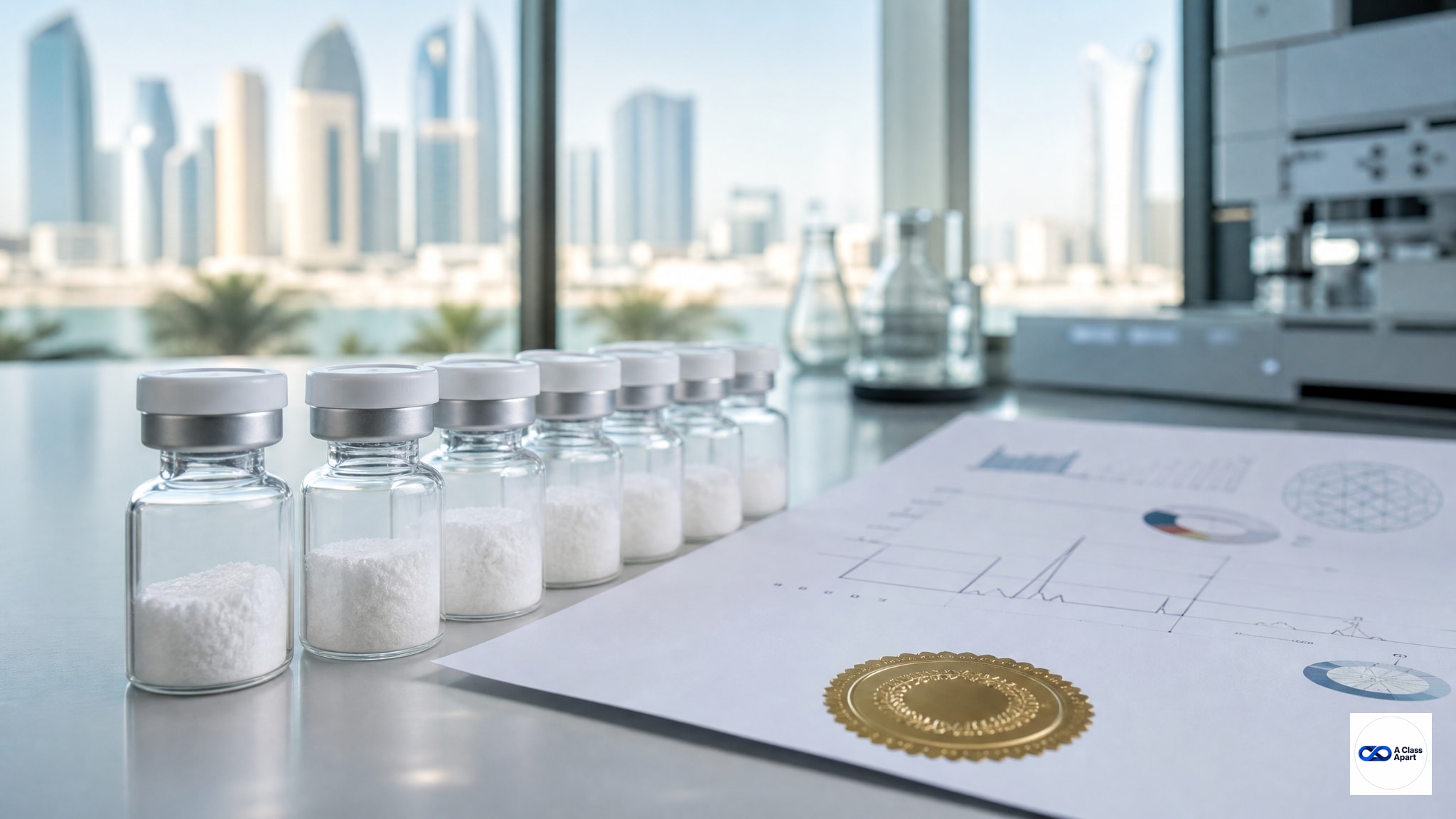
Sourcing a reliable BPC-157 nasal spray research supplier in the UAE means distinguishing verified liquid formulations from unverified products that lack proper analytical documentation. Lyophilized vials dominate the regional market, but nasal sprays bring different variables into play: concentration accuracy, solvent stability, and mucosal safety. Standard powder certificates of analysis don't address any of that. Researchers evaluating BPC-157 nasal spray COA documentation need to confirm the testing happened on the finished liquid product, not on raw material sampled before reconstitution.
The distinction matters because liquid peptide formulations behave differently than dry powders once they hit an aqueous solvent, especially in the high-temperature environments common across the GCC. A Class Apart runs batch-specific verification on liquid formats so your experimental data reflects actual delivered concentration, not theoretical purity. We supply only third-party tested batches suitable for legitimate scientific inquiry. We do not sell these products for human consumption or clinical application.
Analytical Differences Between BPC-157 Nasal Spray and Lyophilized Vials
Moving from lyophilized powder to a pre-formulated nasal spray changes the analytical requirements. The peptide now sits in an active state, degradation kinetics speed up, and solvent interactions become variables that matter for your research validity. A certificate that validates raw powder purity does not automatically apply to the final liquid solution in a spray bottle.
Concentration Accuracy in Liquid Formulations
Lyophilized peptides are typically assayed for net peptide content after correcting for water, salts, and counterions. That calculation stops being enough once the compound enters solution. Liquid formulations need direct measurement of the dissolved species, to account for losses during compounding or adsorption onto container surfaces. A Class Apart mandates batch-specific HPLC analysis for all liquid formulations, verifying net peptide content post-reconstitution and separating verified stock from generic powders.
Skip that step and researchers risk concentrations that deviate significantly from label claims, a known problem with liquid processing. That's why our BPC-157 research peptide supply includes dedicated liquid-phase testing reports instead of repurposed powder data.
Stability Testing Requirements for Nasal Delivery
Stability profiles for nasal sprays have to account for hydrolytic degradation pathways that stay dormant in dry storage but activate the moment the product is reconstituted. Valid nasal spray COAs list sterility and endotoxin levels alongside purity percentages, because those safety parameters don't matter for dry powder but are critical for intranasal research. Excipients, preservatives, or buffering agents in the liquid matrix can also interact with the peptide over time. That calls for real-time stability studies, not extrapolated shelf-life estimates.
Reject any nasal spray product that lacks stability data generated under conditions matching its intended storage and use. Accelerated stability testing at elevated temperatures adds confidence that the formulation holds up during transit through hot climates.
Verifying BPC-157 Liquid Formulation Purity via Third-Party Labs
Independent laboratory verification is the primary defense against mislabeled or degraded research materials circulating in regional markets. Your ability to reproduce experimental results depends entirely on receiving material that matches its documentation.
Key COA Metrics for Nasal Sprays
A compliant certificate for BPC-157 liquid formulation research reports net peptide concentration determined by quantitative HPLC against a reference standard, not just qualitative identity confirmation. Sterility and bacterial endotoxin limits are mandatory fields, since intranasal administration bypasses many biological barriers that would otherwise filter contaminants. Trifluoroacetic acid residuals deserve specific attention too: TFA levels acceptable in injectable-grade powders may exceed safe thresholds for mucosal contact.
Purity percentages should come from area normalization at 214 nm with orthogonal confirmation at 280 nm, to catch aromatic impurities invisible at lower wavelengths. Mass spectrometry verification confirms molecular identity independent of retention time, which prevents substitution errors that HPLC alone might miss.
Identifying Red Flags in Unverified Products
Unverified liquid peptide products frequently show concentration variances beyond acceptable research tolerances, usually from solvent evaporation or improper initial compounding. Certificates missing specific test dates, instrument serial numbers, or analyst signatures point to document fabrication rather than genuine analytical work. Generic PDFs reused across multiple batches without lot-specific data mean the supplier never actually tested what they shipped.
Our guide on identifying fake peptide COAs covers more warning signs, including inconsistent formatting, missing chromatograms, and purity values reported to suspicious precision. Cross-referencing third-party lab accreditation against international databases like ISO 17025 registries helps separate legitimate testing facilities from shell companies set up solely to generate fraudulent documentation.
Storage Stability for Peptide Nasal Sprays in GCC Climates
Ambient temperatures in the UAE regularly exceed the thresholds where liquid peptide degradation accelerates sharply, which makes cold-chain management non-negotiable. Lyophilized powders tolerate brief heat exposure during transit. Pre-formulated liquids start degrading the moment thermal protection fails.
Temperature Sensitivity of Liquid BPC-157
Liquid peptide formulations in GCC climates carry significantly higher hydrolysis risk than lyophilized counterparts, which is why they need validated cold-chain logistics rather than standard ambient shipping. Hydrolytic cleavage of the peptide backbone proceeds faster in aqueous solution at elevated temperatures, reducing effective concentration even when the product still looks fine. Oxidation of methionine residues is another temperature-dependent degradation pathway specific to liquid storage.
Ask for stability data showing product integrity after simulated transport excursions that match worst-case regional delivery scenarios. Products shipped without continuous temperature monitoring give you no assurance that what arrives matches the batch that was tested.
Cold Chain Logistics Within the UAE
Validated cold-chain protocols hold 2–8°C from warehouse dispatch through final laboratory receipt, using phase-change materials sized for the expected transit time and ambient heat load. Temperature loggers embedded in each shipment create an auditable record of thermal compliance for the whole journey. Our article on peptide storage in hot climates explains why even brief exposure above the recommended range compromises liquid formulations for good.
Warehousing facilities need redundant cooling systems with backup power to prevent inventory loss during grid failures. Last-mile delivery also needs partners trained and equipped for temperature-sensitive biologics, not a standard courier.
Sourcing Transparency and Chain-of-Custody for UAE Researchers
A documentation trail from synthesis facility to receiving lab bench establishes accountability at every transfer point where adulteration or substitution could occur. Grey-market vendors without verifiable custody records can't guarantee that what arrives at your door actually came from the manufacturer named on the certificate.
Chain-of-custody documentation should include manufacturer batch records, export licenses, customs clearance paperwork, and domestic distribution logs, each tied to specific personnel and timestamps. Third-party testing should happen after domestic receipt, not before export, to confirm material integrity survived international transit. Suppliers unwilling to share complete custody documentation are likely sourcing from intermediaries whose quality controls stay opaque.
Regulatory compliance within the UAE requires proper import classification and adherence to controlled substance scheduling where applicable. Legitimate suppliers hold current trade licenses and regulatory approvals showing they're authorized to handle research chemicals domestically. When you buy research peptides in the UAE, insist on seeing these credentials before you pay.
Traceability should also extend backward to raw material suppliers and forward to disposal protocols for unused inventory. Full transparency lets you investigate retrospectively if experimental anomalies point to a material-related cause.
Common Quality Failures in Regional BPC-157 Spray Markets
Knowing the common failure modes helps researchers catch problems before they wreck months of experimental work. Market surveillance keeps turning up the same systemic issues among unverified suppliers serving GCC research communities.
Underdosing and Solvent Degradation
Incorrect mg/mL concentrations come from improper reconstitution calculations, volumetric measurement errors during filling, or deliberate dilution to stretch inventory. Solvent evaporation through imperfect seals concentrates the remaining solution while promoting oxidative damage to exposed peptide molecules. Buffer pH drift over time creates acidic or alkaline conditions that accelerate degradation beyond predicted rates.
Particulate formation signals protein aggregation or precipitation, which renders part of the dose biologically unavailable. Microbial contamination proliferates fast in aqueous solutions that lack adequate preservative systems or sterile filtration. These failures show up inconsistently across batches, so reproducibility is impossible without rigorous incoming inspection.
Misrepresented COA Documentation
Fabricated certificates copy the formatting and terminology of legitimate sources while swapping in fictional test results. Some vendors test one representative batch, then apply those results indefinitely across every production run after it, with no revalidation. Others test raw powder, then issue certificates that imply liquid formulation verification that never actually happened.
Chromatogram images get photoshopped or recycled from unrelated analyses to create a false impression of thorough testing. Purity values rounded to whole numbers suggest estimation rather than precise instrumental measurement. Authentic laboratories report results reflecting actual instrument output, decimal places and measurement uncertainty ranges included.
Cross-contamination from shared equipment shows up as unexpected peaks in chromatograms, peaks that fraudulent documents conveniently leave out. Only independent retesting by accredited third-party laboratories reliably catches these deceptions before you've committed to the experiment.
Ordering Lab-Verified BPC-157 Nasal Spray in the UAE
Researchers looking for verified BPC-157 nasal spray formulations should start by requesting current batch-specific certificates of analysis before placing an order. Reviewing the documentation confirms the available inventory lines up with your experimental requirements on concentration, volume, and testing parameters. A Class Apart supplies only materials accompanied by complete third-party verification packages suitable for publication-quality research.
Order processing starts only after we confirm recipient credentials and that the intended research application complies with applicable regulations. Shipping schedules align with cold-chain carrier availability to minimize weekend hold times at uncontrolled facilities. Each delivery includes temperature logger data download instructions so you can verify the shipment the moment it arrives.
Post-delivery support covers questions on handling, storage, and documentation specific to liquid nasal spray formats. Batch reservation holds inventory pending institutional procurement approval when administrative timelines run longer than standard holding periods. Contact our team today to request current COAs and talk through your BPC-157 liquid formulation research requirements.


Comments