
Tesamorelin Research Peptide UAE: Documentation Guide

Updated: Oct 1
Sourcing a reliable Tesamorelin peptide supplier in the UAE means telling apart generic catalog listings from vendors that provide batch-specific analytical documentation. Many regional suppliers offer growth hormone-releasing peptides without a Certificate of Analysis attached, leaving researchers to verify purity on their own or accept unverified specifications for critical assays. A Class Apart provides UAE delivery information and storage guidance. Researchers should confirm the packaging and temperature-handling arrangements required for a specific material before ordering. This matters because reproducibility depends on knowing exactly what's in the pre-filled pen before reconstitution starts.
Sourcing Tesamorelin Research Peptide in the UAE
Getting high-purity Tesamorelin research peptide in the UAE involves logistical and verification hurdles that don't map neatly onto North American or European supply chains. Product availability here often outpaces quality assurance infrastructure. That makes vendor selection a variable you have to control for, not an afterthought.
Regional Availability for GCC Laboratories
Local inventory cuts transit time, but it doesn't guarantee analytical rigor or proper cold chain handling during domestic distribution. A supplier worth using understands that regional availability means nothing if the peptide degraded before it reached your bench. A Class Apart holds stock specifically for GCC laboratories while sticking to international testing protocols, so geographic convenience doesn't cost you data integrity. A Class Apart provides available product and batch information on request. Researchers should confirm that any analytical document matches the specific lot before purchase or experimental use.
Distinguishing Verified Suppliers from Generic Listings
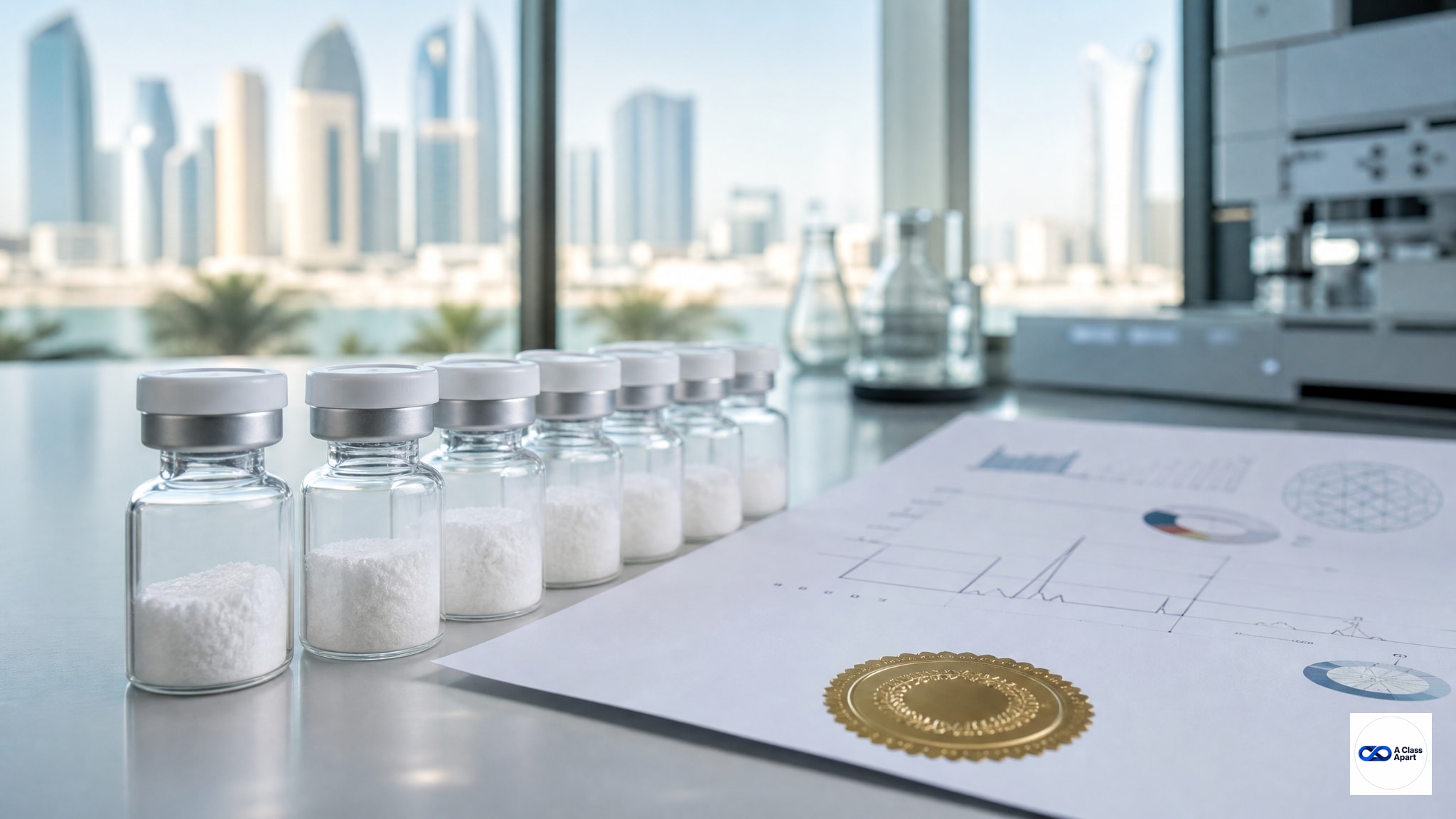
Most vendor pages display a static purity claim that stays unchanged across years of sales and multiple production batches. A legitimate documentation-focused Tesamorelin supplier updates its documentation with each manufacturing run, because synthesis yields and impurity profiles shift naturally between batches. If a product page lists a fixed purity percentage with no downloadable or requestable COA dated to the current year, treat the listing as marketing material, not a scientific specification. Requesting current batch documentation before you buy is the only way to confirm the physical inventory matches what's advertised.
Decoding the Tesamorelin Certificate of Analysis (COA)
A valid COA is the primary interface between manufacturer quality control and researcher confidence, yet plenty of documents circulating in the peptide market lack the granular data needed for independent verification. Understanding peptide COAs means looking past the headline purity number to the analytical methods and raw data behind it.
Critical Purity Thresholds and HPLC Data
Research-grade peptides typically need a minimum purity threshold of ≥98% by HPLC to be suitable for sensitive in vitro and in vivo assays. The COA must state whether this percentage reflects net peptide content or gross weight, the two produce very different molar concentrations once you calculate dosing for cell culture or animal models. Net peptide content excludes water, salts, and counterions and reflects only the active molecule mass. Gross weight includes everything else in the lyophilized powder. Accept a COA reporting gross weight purity without that clarification, and you've introduced systematic error into every concentration calculation your team runs afterward.
Verifying Molecular Weight and Mass Spectrometry
HPLC retention time confirms that something elutes at the expected point. Only mass spectrometry proves the eluting compound is actually Tesamorelin with the correct amino acid sequence. Your COA should include MS data showing an observed molecular weight matching the theoretical monoisotopic mass of C₂₂₆H₃₇₀N₆₀O₆₈ within acceptable instrument tolerance. Without that orthogonal confirmation, you can't rule out a deletion sequence, a truncated fragment, or an entirely different peptide that happens to share similar hydrophobicity. Cross-referencing the MS peak against the stated sequence takes less than five minutes, and it saves months of wasted work on misidentified material.
Tesamorelin Purity Testing and Quality Standards
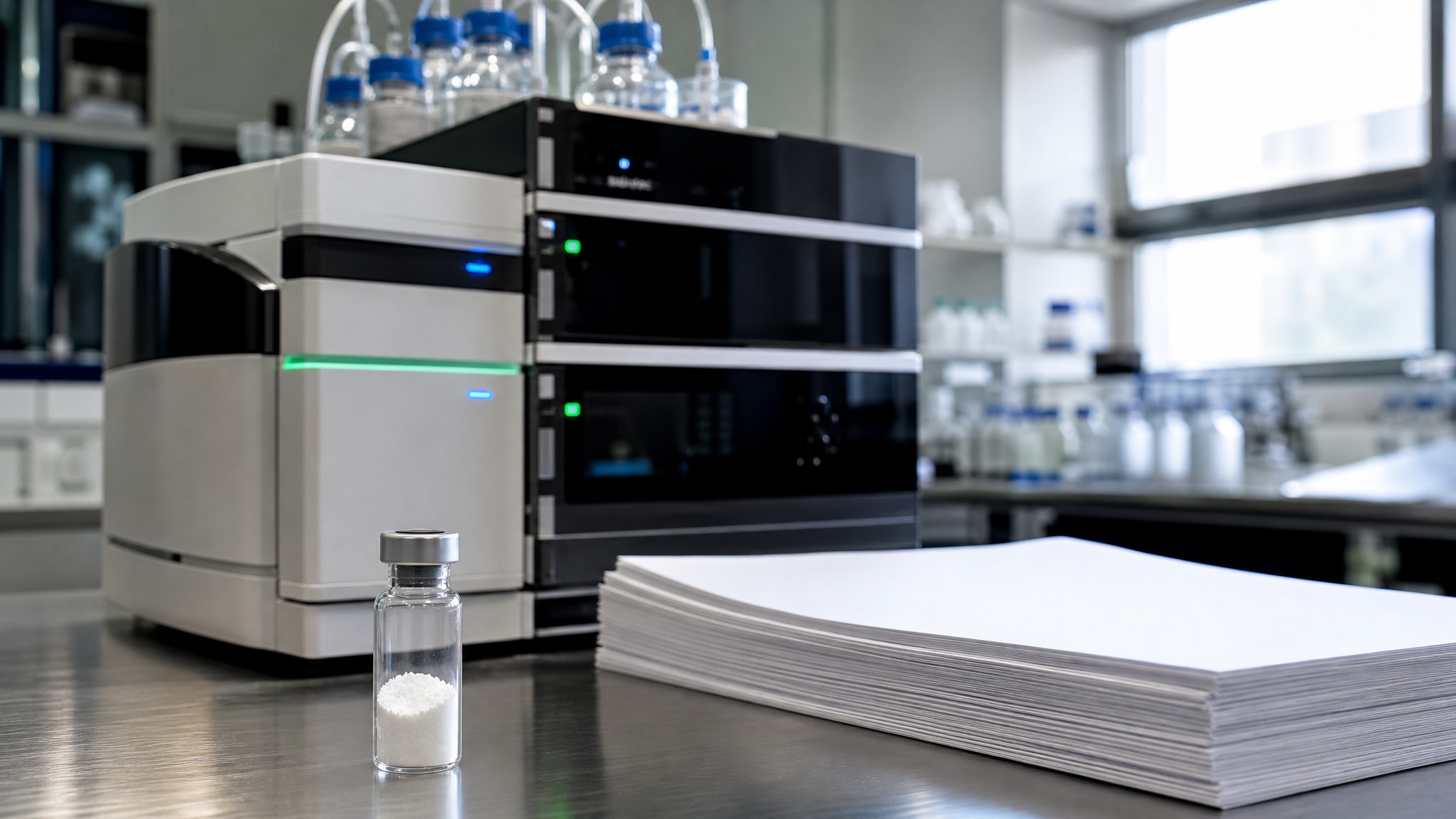
Analytical validation is what separates research-grade material from cosmetic or supplement-grade powder, and the distinction comes down to which testing methods the supplier actually runs. Valid Tesamorelin verification calls for both HPLC, for purity assessment, and mass spectrometry, for molecular confirmation. A single testing method leaves room for misidentification that can sink an entire study.
HPLC vs. MS: Why Dual Verification Matters
High-Performance Liquid Chromatography measures chemical purity by separating compounds on polarity, but on its own it can't identify unknown impurities or confirm primary structure. Mass spectrometry identifies molecular identity by mass-to-charge ratio, but it gives limited quantitative information about trace contaminants that could interfere with receptor binding assays. Run both, and you get a cross-check: HPLC quantifies the main peak and related substances, MS confirms that main peak is full-length Tesamorelin. A supplier offering only one method is handing you an incomplete characterization, and it doesn't meet current biochemical research standards.
Identifying Red Flags in Third-Party Lab Reports
Third-party testing only adds credibility when the lab itself is identifiable and the report carries traceable metadata linking it to your specific batch. Identifying fraudulent documentation starts with checking whether the testing facility's name, accreditation status, and sample receipt dates show up consistently across the header and footer. Reports generated from template software often show mismatched fonts, inconsistent decimal formatting, or chromatograms that look identical across different products and batch numbers. If you can't contact the third-party lab directly to verify the report using the certificate number printed on your COA, the document tells you nothing, no matter how polished it looks.
Tesamorelin vs CJC-1295: Research Distinctions
Procurement errors happen when researchers lump growth hormone secretagogues together based on functional similarity instead of structural specificity. Tesamorelin and CJC-1295 both stimulate endogenous growth hormone release, but they get there through distinct molecular mechanisms, and that dictates where each belongs in an experimental model.
Tesamorelin is a synthetic analogue of GHRH(1-44) modified with an E-2-hexenoic acid group at the N-terminus, which enhances metabolic stability while retaining selective affinity for the pituitary GHRH receptor. CJC-1295, by contrast, is a GRF(1-29) analogue typically conjugated to a Drug Affinity Complex or maleimidopropionyl-Lys linker, built to extend half-life through albumin binding rather than receptor selectivity. Tesamorelin produces pulsatile GH secretion that mimics physiological patterns. CJC-1295 generates sustained elevation that may desensitize somatotrophs over extended exposure. Reviewing CJC-1295 research specifications alongside Tesamorelin data helps you match procurement to the secretory profile your assay actually needs, rather than assuming the two are interchangeable because they both raise downstream hormone output.
This distinction determines which compound belongs in your protocol.
Storage Guidelines for Tesamorelin in Hot Climates
Peptide stability degrades fast once thermal and humidity controls fail, and that risk climbs sharply in the UAE's ambient conditions. In high-humidity environments like the UAE, lyophilized peptides exposed to ambient temperatures during last-mile delivery can undergo accelerated hydrolysis if cold chain protocols break down anywhere between warehouse and lab.
Cold Chain Integrity During GCC Transit
Temperature excursions during domestic courier handoffs are the most common failure point for peptide integrity in regional logistics. Ask for shipping documentation that includes temperature logger data, or validated insulated packaging rated for the expected transit duration and seasonal extremes. A package that feels warm to the touch signals potential degradation even if the lyophilized cake looks visually intact, hydrolytic damage happens at the molecular level well before any visible clumping or discoloration shows up. Rejecting a compromised shipment on arrival protects your data far better than trying to salvage the material with post-hoc purity testing.
Long-Term Lyophilized Stability Protocols
Lyophilized Tesamorelin stays stable for extended periods when stored desiccated at -20°C or below, but repeated freeze-thaw cycles after reconstitution speed up aggregation and oxidation. Aliquot reconstituted solutions into single-use volumes as soon as you prepare them, so the master stock never has to cycle between freezer and benchtop temperatures. Store aliquots at -80°C for long-term preservation, or -20°C for short-term use spanning several weeks, and keep samples sealed with desiccant to keep moisture out. Following storage protocols for humid regions keeps the purity verified on the COA at manufacture intact through the length of your experimental timeline.
Responsible Procurement for Dubai Research Labs
Acquiring Tesamorelin in Dubai carries regulatory and ethical obligations that go well beyond picking a vendor with competitive pricing. All transactions must comply with UAE federal regulations governing research chemicals, and a supplier operating legitimately will verify your institutional affiliation before fulfilling an order. This peptide is supplied exclusively for non-human laboratory research. It is not approved for clinical administration, therapeutic use, or human consumption under any circumstances. Transparent supply chains protect both buyer and seller by leaving an auditable record of compliant intent and proper end-use documentation. Contact our team to request a current batch COA or check Tesamorelin availability and specifications before you order, or browse verified research peptides to review the full catalog of analytically characterized compounds.
Research-use notice: For laboratory research use only. Not for human or veterinary use, and not intended to diagnose, treat, cure, mitigate or prevent disease.
Explore the A Class Apart research catalogue or enquire via WhatsApp on +971 52 627 8691. Free UAE delivery is available on orders from AED 1,000, and payment via WhatsApp can be arranged if preferred.

Comments