
Third-Party Tested Research Peptides: Why Verification Matters

Updated: Sep 29
A Class Apart provides available product and batch information on request. Researchers should confirm that any analytical document matches the specific lot before purchase or experimental use. Fewer explain what that testing actually involved, who performed it, or when. For researchers in the UAE and across the GCC sourcing peptides for legitimate study use, that gap matters. A label that says "third-party tested" is only useful if it points to something a researcher can independently check. This article breaks down what that phrase should mean, what a real certificate of analysis contains, and what to ask before you trust a supplier's purity claim.
What "Third-Party Tested" Actually Means for Research Peptides
Third-party testing means an independent laboratory analyzes a sample and reports the result. The lab has no ownership stake or financial relationship with the vendor. It has no incentive to inflate a purity figure or hide contamination. Its only job is to report what the instruments found.
This distinction matters more than it might first appear. A vendor that tests its own products in-house is grading its own homework. Even with good intentions, in-house testing carries a built-in conflict of interest. The same party that profits from a high purity number is the one generating it.
Independent Peptide Testing vs. In-House Testing
In-house testing isn't inherently dishonest. Many manufacturers run internal quality checks as part of normal production control. But internal results shouldn't stand in for independent verification. A researcher evaluating a peptide for a study needs a data point free from that conflict.
Independent peptide testing solves this by putting a named, external, contactable lab between the claim and the customer. If a vendor won't say which lab tested a batch, there's no way to confirm the analysis happened at all, let alone that it was done correctly.
Reading a Third-Party COA Peptide Report: What to Look For
A certificate of analysis is only as useful as the details it contains. A vague "passed purity testing" statement tells you almost nothing. A real third-party COA peptide report reads more like a lab document than a marketing sheet.
Lab Name, Accreditation and Test Date
Look for the actual name of the testing laboratory, not just "an independent lab" or "a certified facility." A legitimate report names the lab, provides contact information, and states the date testing occurred. It should also reference a batch or lot number that matches the product you have in hand.
These details exist so a researcher can independently confirm the report is real. If the lab is named, you can look it up. If the test date is recent and tied to the specific batch you purchased, you know the certificate reflects the product you're actually using, not a different production run from months earlier.
Methodology: HPLC, Mass Spec and Purity Thresholds
The report should also state how the sample was tested. High-performance liquid chromatography (HPLC) and mass spectrometry are the two methods most commonly used to verify peptide purity and identity. Both produce a specific numeric result, not a simple pass or fail label.
Credible peptide COAs typically report purity to at least one decimal place, for example 98.6%, rather than a rounded figure like "99%+." That level of precision reflects an actual instrument reading. A rounded number, by contrast, often signals a marketing claim rather than a lab result. If a COA doesn't name a method or give a specific figure, treat it as incomplete.
Why Unverified Vendor Claims Fall Short
The phrase "third-party tested" appears on a lot of peptide product pages with nothing behind it. No lab name. No test date. No batch reference. Just the phrase itself, presented as if it were self-verifying.
This is the gap that leaves researchers unable to check anything. Without a named lab, there's no institution to contact. Without a test date, there's no way to know whether the report reflects the current batch or an old one. Without a stated methodology, there's no way to judge whether the testing was rigorous or superficial.
A claim of testing, on its own, is not evidence of testing. It's a statement that requires supporting documentation to mean anything. Researchers evaluating peptide suppliers should treat an unsupported "third-party tested" label the same way they'd treat any unverified claim in a scientific context: as unconfirmed until the underlying data is available for inspection.
Peptide Lab Verification as Part of Research Compliance
For labs and researchers operating in the GCC, sourcing decisions are part of a broader research integrity picture. Peptide lab verification isn't just a purchasing preference. It's a documentation practice that supports the traceability expected of any legitimate research workflow.
When a study depends on a compound's identity and purity, the paper trail matters. A batch-specific, dated, independently COA Documentation gives a researcher something to reference and archive alongside their own study records. It also gives them something to point to if a compound's provenance is ever questioned.
How This Supports Responsible Research Practices
External peptide quality testing shifts the burden of proof away from a vendor's own word. It puts an outside, disinterested party's data in the loop instead.
This is how responsible research practice generally works. An independent party should check claims about a material's properties wherever practical, not just take the seller's word for it. Sourcing from suppliers who provide this kind of documentation isn't an extra step. It's a basic input into keeping a research program's records defensible.
A Class Apart provides available product and batch information on request. Researchers should confirm that any analytical document matches the specific lot before purchase or experimental use.
A Class Apart provides available product and batch information on request. Researchers should confirm that any analytical document matches the specific lot before purchase or experimental use. This is a deliberate departure from a generic purity statement that applies broadly across a product line rather than to the specific batch a researcher receives.
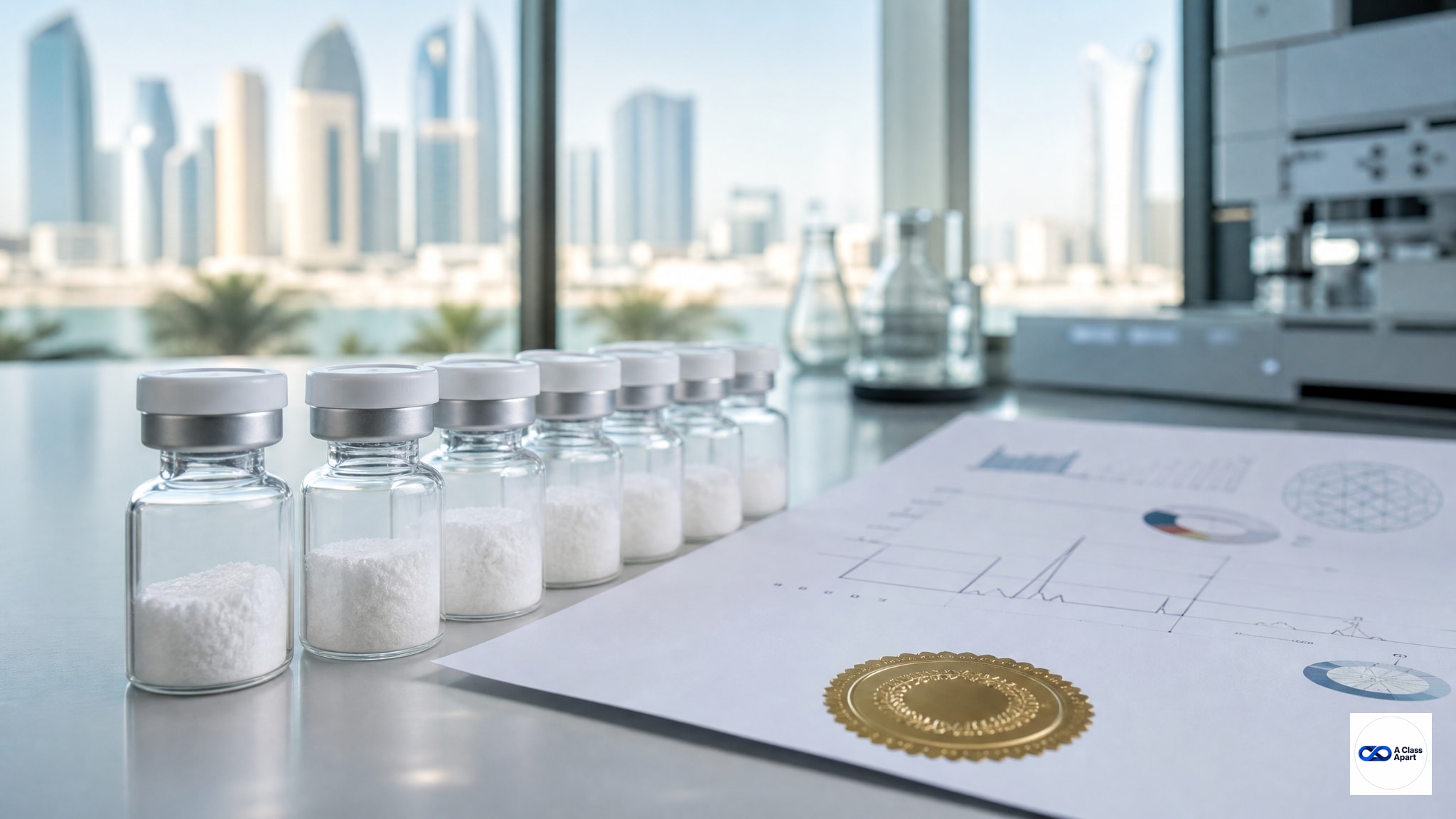
Each COA identifies the testing lab, states the test date, and ties the result to the batch or lot number on the product itself. The reported purity figure reflects an actual HPLC or mass spectrometry reading, not a rounded marketing claim. Researchers can browse the A Class Apart catalogue and request the available documentation for a specific product and batch before ordering.
Checklist: Questions to Ask Before Trusting a Peptide Supplier's Testing Claim
Before purchasing from any peptide supplier, a researcher should be able to get clear answers to the following:
Which lab performed the testing? A named, real, contactable laboratory, not a vague reference to "an independent facility."
When was the test performed? A recent test date tied to the batch you're purchasing, not an old report reused across multiple production runs.
What methodology was used? HPLC, mass spectrometry, or another named analytical method, with the numeric result reported.
Does the batch number on the COA match the product you received? If there's no batch match, the certificate could belong to any product the vendor sells.
Can the lab be independently contacted or verified? If a researcher can't confirm the lab exists and does this kind of testing, the certificate isn't verifiable.
If a supplier can't answer these questions clearly, or the answers aren't documented on the COA itself, that's a reason to look further before purchasing. A Class Apart provides available product and batch information on request. Researchers should confirm that any analytical document matches the specific lot before purchase or experimental use. Favor suppliers that publish a COA Documentation catalog rather than a general testing claim.
Research-use notice: For laboratory research use only. Not for human or veterinary use, and not intended to diagnose, treat, cure, mitigate or prevent disease.
Explore the A Class Apart research catalogue or enquire via WhatsApp on +971 52 627 8691. Free UAE delivery is available on orders from AED 1,000, and payment via WhatsApp can be arranged if preferred.

Comments